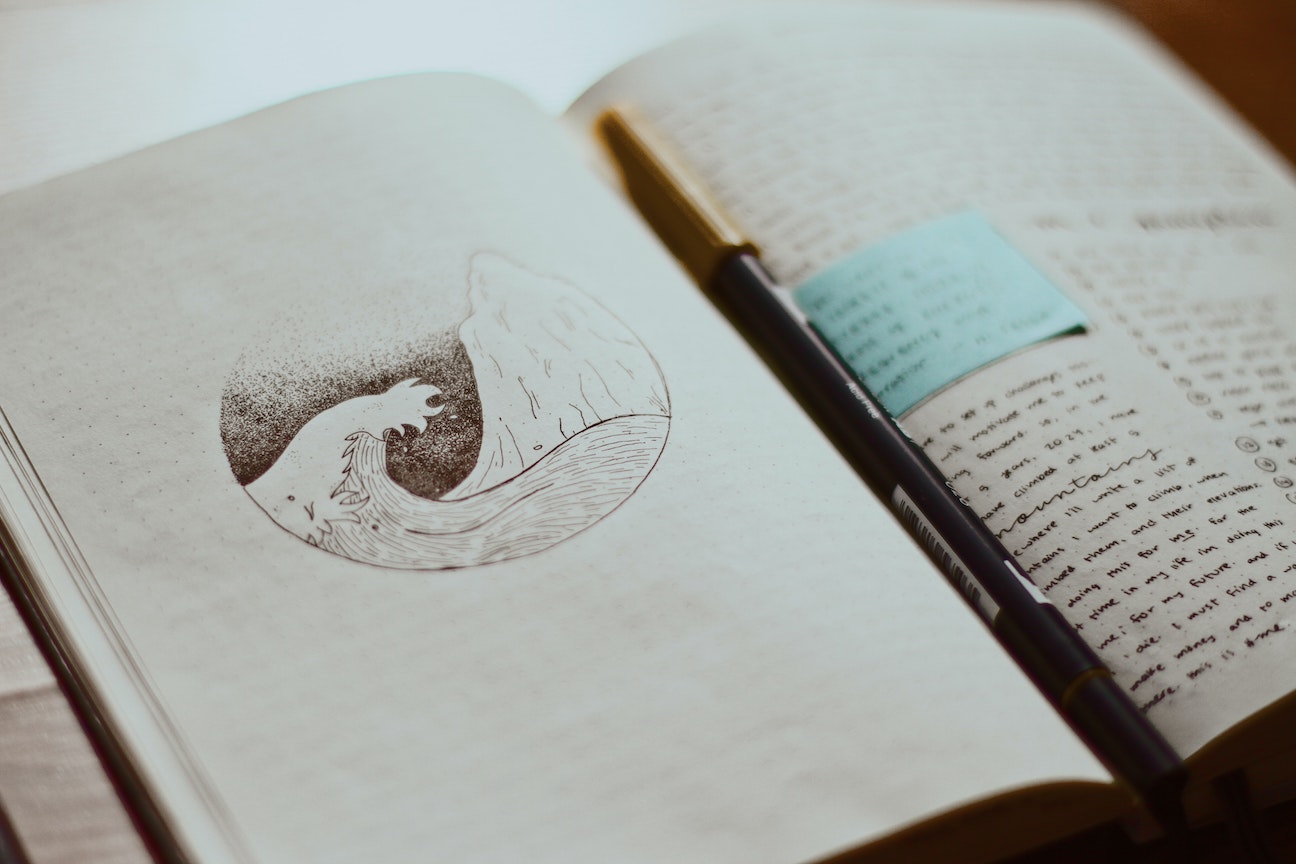
I believe that writers should keep journals, because that’s where we truly write for ourselves, and what good is a story that we ourselves don’t want to see in print?
Along those lines, I do enjoy reading famous authors’ journals. Not that creeping is my pastime or anything, but with entries like this, why would I not?
There is not one big cosmic meaning for all; there is only the meaning we each give to our life, an individual meaning, an individual plot, like an individual novel, a book for each person.
Anaïs Nin, The Diary of Anaïs Nin, Vol. 1: 1931-1934
Nin also wrote: ‘It’s writing what interested me genuinely, what I felt most strongly at the moment, and I found this fervour, this enthusiasm produced a vividness which often withered in the formal work.’
As someone who’s written a lot for ‘formal work’, I have to say that she’s on to something there.
Why journal as a writer?
So maybe you don’t keep this habit, and you want me to convince you. Better still, you want me to tell you how it could benefit you as a writer. Well say no more! Here are some totally scientific benefits to get you started with.
1. It gets you writing
Here’s some good news for you procrastinators out there: Journalling is considered writing. Yes, even that whiny post about how the barista at Starbucks forgot to put whipped cream on your latte.
And writer’s block? You’ll find no such thing here. Maybe the fear of dirtying your expensive journal will lurk around for a bit, but you’ll get over that pretty quick.
There’s no audience to pander to, no expectations. You’re simply recording your thoughts, as most writing should be. More importantly, the more you write this way, the better you become at listening.
Listening for what, you may ask?
The universe! Yes, we skim the borders of woo-woo land from time to time, and today, I’d like to use my quota to share my observations with you: That we’re receivers, and our thoughts are the radio waves from the ether.
Some people call it listening to your muse, communicating with the divine, or simply accessing your higher self. Whatever it is you choose to believe, you can be sure that journalling will help forge that connection.
Totally scientific, is it not? Told you it’d be!
2. You get to practice habit-building
Once you get into the groove of journalling, you’ll probably have a set time and place to do it. I prefer the evenings, when I have an entire day’s worth of material to choose from.
And after you fall into said groove, you’ll discover that writing a novel isn’t that much different. You set a time, you show up, you fill up the page.
An added lesson you’ll gain is the gift of seeing your tiny efforts turn into something substantial. If you stick to your—hopefully painless—practice for long enough, you’ll end up with an entire notebook filled with your own words and thoughts.
If you need convincing on what 250 words a day can do, I can’t think of a better example than to journal.
3. You learn how to perform (without an audience)
I have a secret: I journal as if somebody else would read it. Sure, nobody really cares, but with posts like this, who knows what could happen?
Yes, the chances are low that my journals would grace a 22nd Century social-media platform, but hey, better to be prepared, eh?
And maybe someone would enjoy my work, and I’d get to entertain tens of thousands of people in the future, just like this housewife did in the link above.
The journal is a great way to practise your performative side of writing. And you can really ham things up too, because by the time someone puts your journal on blast, you’ll probably be too dead to be embarrassed.
Oh, also, you know that thing about writing voice? This is the best place to hone it.
4. It reminds you that the work is the gift
I’m not gonna lie, most of you probably won’t feel that much different from journalling. It’s not as if keeping the habit will turn you into a Steinbeck or Plath overnight.
So sticking to this habit requires intrinsic reasons. And for those of you who do stick to it, you’ll learn that the work itself is the gift.
Because like many other things in life, simply aiming for the end goal isn’t going to provide you with any sustainable purpose.
But if actually enjoy an activity just for its own sake, you’ll learn that perhaps this is how you should be approaching writing, a craft that you’re willing to work at, no matter what the results.
And maybe you’ll discover that writing isn’t the thing for you, and that’s okay too, because that opens up the space for you to find your work.
5. It keeps you on track
What do you do when you read a post from a year ago that says ‘I can’t find the time to write’? And what happens if that theme repeats itself over and over?
You’ll start to think, that’s what. And if you keep telling yourself you don’t have the time to write, then you’re either not putting in enough effort, or you’re really short on time and have to make some adjustments to your life.
Either way, having an external source tell you what you need to do does give you an added perspective, even though that external source is still you.
My own journals are filled with the whiniest posts, and I never connect the dots until I open a notebook from yesteryear, and realise that the problems I have are still the exact things I struggle with today.
Being the lazy slob that I am, I might not even start addressing said problems, but at least they’re on my radar. Maybe that’s why I’ve been on my longest no-alcohol streak to date. Because I got fed up of seeing ‘I drank again’ posts.
Also, it helps keep my writing in check. Every other entry I ask myself if I’m doing enough to reach my writerly goals, and every time the answer is no. So I probably have that to thank for this blog post.

How do you start?
Keeping a journal is a fairly straightforward process, but if you’re the type of person who prefers knowing everything before taking a single step, then this section’s for you.
1. Give your day a title
Think of your life as a movie. What title would you give your day? Imagine Trailer Voice Guy announcing the arrival of your movie. What would that be like?
It’s almost bullet journal-ish in nature, and it’s a great way to build the daily habit without committing too much.
Sure, everybody has their process, and some writers binge while other maintain a more consistent practice. But if you’re just starting out, the best thing to do is to do it every day. Because we want to build the neural networks in your brain (totally scientific, right?).
So start off with a one-sentence summary a day if you’re new to journalling. Sound good?
2. Examine your day
I forgot which episode this was, but in one of Matt D’Avella podcasts was a discussion on the three things you should ask yourself every day. These questions help you notice any patterns you have in your life, allowing you to adjust as you see fit. And they are:
- What made me feel more energetic today?
- What drained me today?
- How could I have improved my day?
I’ve used these questions for years, and it’s the sole reason why I’ve learned that drinking every day wasn’t exactly filling me with joy, even though I thought it was helping me unwind.
If those prompts don’t do it for you, try this interesting list from The Grief Reality.
3. Go micro
All right, so you’ve journaled for a bit and writing doesn’t intimidate you anymore. Time for some writer-style journalling.
You can now start exploring your voice, and the way you do that is describing a certain point in your day as best you can. Maybe you want to write about the joys of cuddling your dog.
You can dive deeper and describe how she nudged your hand when you stopped stroking her, and how her wet nose left a patch of coolness on your cheek. Recall what you were thinking, how the soft the couch was, how you’d overheard your neighbour’s conversation…
It’s not only fun for future you to read, but it’s also a great way to practise your style. I call this ‘sketching’ a scene with words, and this skill comes in handy when it comes to descriptions in your novels.
4. Hone your focus
Journalling can be like meditation if you want it to be. That means no screens or electronics nearby while you jot down your thoughts. Set fifteen minutes on the clock and concentrate solely on your journal.
Not only is this beneficial for other tasks in life, but it’s also a great way of cultivating mindfulness, and we all could use a bit more of that, couldn’t we?
How you do anything is how you do everything, and with enough practice focusing only on one thing at a time, you’ll be able to reclaim your focus, which you can then use in your writing.
5. Go third-person
Want to kill two birds with one stone? Write in third person and gain the benefits of journalling, plus the chance to practise your art.
What you do is describe your day—or what’s currently happening—from a narrator’s perspective. Make up a random personality each time you write. Sometimes the narrator might paint you in a snarky light. At other times, they could be rooting for you.
Think Morgan Freeman narrating your day. How cool would you doing your chores be (at least in your head)? Do that with various personalities and see how your stories change. Who knows? Maybe somewhere in that mishmash of random personalities lies your true voice.

Start journalling and your writer-self will thank you
You know what’s a great thing to have? A journal from ten years ago describing the days you’d have totally forgotten otherwise. You know what’s also fun? Comparing your writing from then till now.
And if you’re anything like me, the cringe fest that follows will serve as a reminder that there’s no perfect story, that you might as well keep writing and sharing, because you always change, and what’s good today may not be decent tomorrow.
Whatever the reason, you will be glad you kept a journal. Don’t let the days pass you by. There’s magic in each and every day. You just have to look for it.
And if you don’t believe in magic, you could at least believe in science.


 Stuart Danker
I’d love to hear your thoughts!