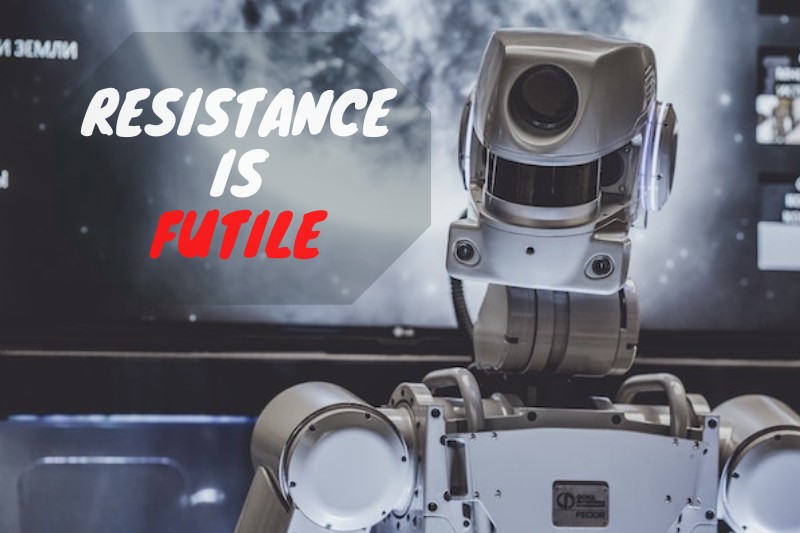
Just one year after I wrote this post about AI and writing, ChatGPT was released into the world, threatening to disrupt so many fields from programming to copywriting.
Naturally, I had my pitchfork at the ready. AI is going to take my job! I thought. Every creative in the world is doomed!
Then I remembered I was jobless.
Anyhoo, I decided to play around with the thing and see if creative writing was really doomed to a future of algorithms or if us writers could benefit from wielding this Star Trek tech. And here’s what I’ve learned.
1. Garbage in, garbage out
You know what I like about ChatGPT? It’s that it can crank out posts faster than I can load up the WordPress editor.
I must say I’m pretty impressed, but other writers don’t share my sentiment. They say ChatGPT writes like a child and that it comes up with terrible jokes. I have no idea what prompts they were feeding it, but I’d like to think that “Why did the banana go to the doctor? Because it wasn’t peeling well” is pretty damn funny.
But you can’t just say ‘write me a story’ and expect to be happy with the results.
Speaking of being happy, we come to my next point: that a human still needs to QA the work. And since we’re all different, we’ll essentially be approving prose at different levels.
Yup, we’ll essentially leave writing behind to become editors. Some of us will be happy with 500 words of anything. Others will wring ChatGPT dry, asking it to rewrite a dozen times from multiple angles before getting what they’re happy with (so, like my previous boss).
And while I’m convinced that AI will level the playing field when it comes to output, it’s still up to the human to shape the reading experience, and you’ll need skills for that.
2. People will still flock to brands
I trawl the secondhand book groups on Facebook a lot, and there’s one thing I’ve noticed: big names will always sell, no matter the title.
Think about your consumption habits. In fact, let’s throw you into a future where the internet consists mostly of AI-generated content. What would you do then? Seek out the best robot journalists, or your favourite writer?
The moral dilemma comes when every writer uses ChatGPT as if it’s Microsoft Word, but that’s where branding comes in. It won’t matter if some rando from Tel Aviv can generate content about Stoicism, because people like Ryan Holiday will have so much more credibility on the subject, AI-enhanced or not.
This will also mean that surface-level writers will need to elevate beyond just writing, and learn complementary skills like marketing and social media management.
It’s like writing a novel and realising that having a successful authorship involves so much more than just finishing your manuscript.
3. AI has no soul. At least not yet.
After an entire month of tinkering with ChatGPT, I have to say that the results can be repetitive and uninspired at times. And it can probably receive the prompt ‘write me a joke’ so many times before coming up with that banana peel one again.
Plus, it has no bones to break, so it probably can’t tell you a story about how it fell in the bathroom and had to go to the hospital alone because it was arguing with its ex-girlfriend (oh dear, how juvenile that post was).
Nor can it tell you a story about how it cut the hair of an airline tycoon on the second day of its job (and by job I mean writer, not hairdresser).
Even as the tech improves, I suspect that there’ll still be a market for experiential posts that’ll never go away. Like hotel reviews, for example, or thoughts on a five-course meal.
That is until we come up with something like Ex Machina. Then we’re all doomed.
What I think moving forward
Looking at how fast tech is moving, I wouldn’t be surprised to have to update this post before the year is up. But as someone highly interested in the developments of AI and writing, here are my initial forecasts on the subject.
a. Writers will need to evolve
As confident as we are with our wordsmithery, there’s no denying that we’re only at the baby stages of the game. And if ChatGPT is this competent now, then writers will need to graduate from listicles (I’m screwed) or Fiverr services, because generic writing will soon be the domain of the machine.
New jobs will crop up though. Maybe there’ll be new departments for AI plagiarism. Maybe AI Handler will be a new job title. I don’t know. All I know is that social media was once seen as a waste of time. And now look at the job vacancies surrounding it.
So if you enjoy writing and want to stand out, it’s time to pivot into more specialised content. But that shouldn’t be new to you if you’ve been writing for a while.
It’s just like how SEO is a growing requirement for writers today. Like how MS Word was once a new skill you had to learn. Like how a typing speed over 60 wpm was once a job requirement.
Basically, keep adapting.
b. Writers will naturally elevate
Once the influx of fake authority arrives, gone will be the demand for Buzzfeed-like posts. And AI will only take that into overdrive.
But the technology will also allow writers to enhance their research, so what would’ve taken hours to outline could end up taking minutes. AI will also be useful as a sounding board, where novelists can discuss plot accuracy through questions like ‘will someone explode in space’.
So more and more we’ll see writers going beyond just writing and taking on research- and curation-heavy roles.
c. AI will just be another spoke in the wheel
Photoshop didn’t kill old-school illustrators. Nor did Canva kill Photoshop. And as far as technology has advanced in recent years, the demand for actual, talented artists like Kim Jung Gi (RIP) or Paul Heaston has never wavered.
Similarly, Uber didn’t kill taxis. It changed the game. You can be adamant about sticking to tradition and keeping your radio receivers and liveried cars, or you can port your trade over to the new way of ride-hailing.
No more will job applicants need to google ‘how to write a cover letter’. Instead, they can directly summon a template that they can edit. Same thing, different process.
Provided the tech remains free, that is. Which brings me to…
d. It’ll be a service
Photoshop ain’t free. Neither is MS Word. When the AI movement takes over as the search engine of the future, it’ll only be a matter of time before it becomes a money-making machine. Think of the ads. The pay-per-use. The paywalled content.
Oh, and if Google search loses its standing in the future, then SEO will cease to matter, or at the very least, we’ll be optimising for AI instead of search engines.
It’s going to be a cyberpunk future and I’m going to love it.
e. The content game will change
As more lower-level writers enter the market, more plug-and-play content will be released as is. There’ll only be so many unique posts prompted by ‘write a blog post about how to be rich’.
But that won’t matter if people use AI as a form of search, because nobody will read posts on how to start a blog when they can just ask the machine.
Because of this, content creators will need to make sure they stand out. And the best people will do it by showcasing their humanity. Since the burden of research will be lessened, it’ll be easier to come up with comprehensive long-form posts too. Which is good, since basic posts will probably be phased out.
I suspect that search engines and major tech companies might also find a way to certify content as authentically written by humans.
I might be totally wrong
At the end of the day, these are just speculations on my part, so take them with a grain of salt. I might end up being wrong, but as they say, to err is human. And there’s no better time than now to be one.
Sign up to my newsletter so you can receive authentically-human content. You’ll also get a free guide on how to grow your WordPress audience, for free! Did I mention it’s free?


I’d love to hear your thoughts!