
Boy do I have a treat for you today.
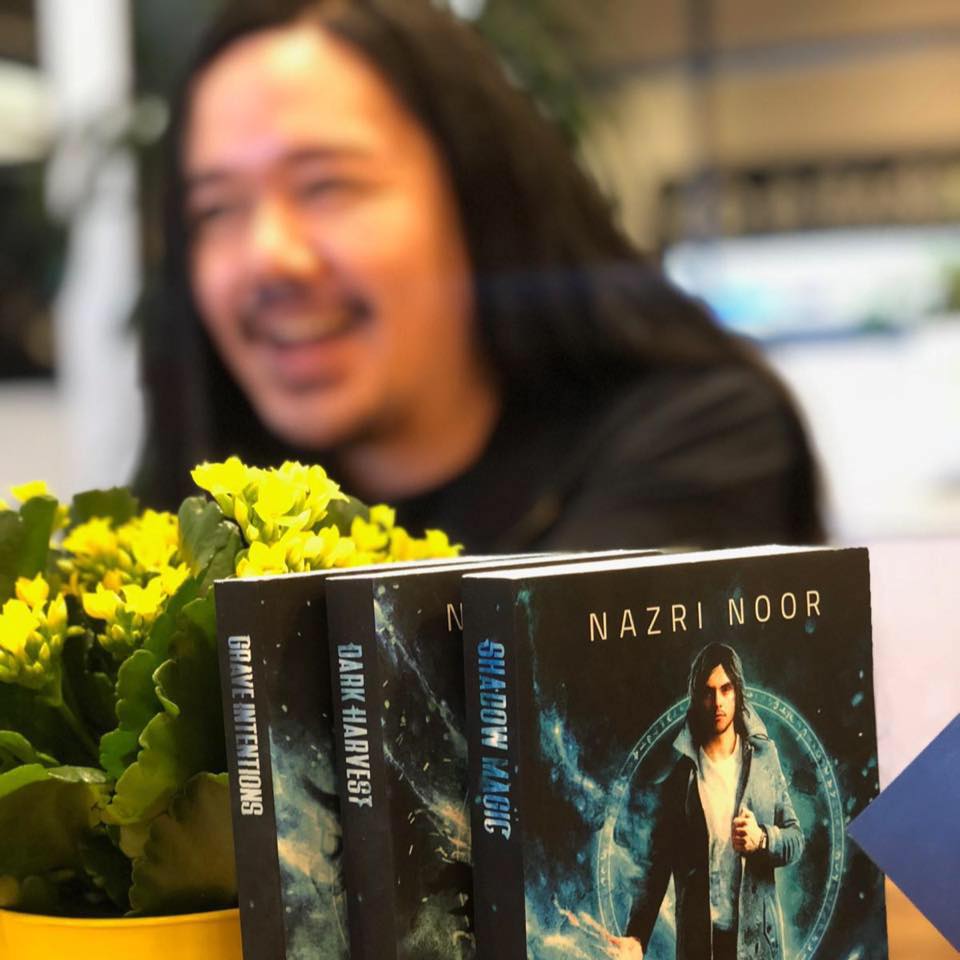
I discovered Nazri Noor back in 2018 when I was still finding my own path in fiction. I was impressed by his ability to earn a living through self-publishing, and had always wanted to ask him how he did it.
Well, that day has arrived. Not only was Nazri kind enough to answer my questions, he also shared a ton of wisdom he’d gleaned from his journey thus far.
So grab a cup of coffee and kick your legs up, because this is going to be a long but enlightening post!
1. Let’s start with the start. How did you get into self-publishing?
I’d actually just moved to the US and was in between jobs at the time. I’d been working in journalism in both Malaysia and the Philippines, but had concerns that none of my experience and networks would really translate to an American work environment.
That was when I learned about Kindle Direct Publishing. My first attempt was under a pseudonym. Reviews were encouraging, but sales were not. I adjusted course, brushed up on my craft and understanding of fiction tropes, then waded into another genre as myself, using everything I’d learned.
The first few months under my pseudonym were illuminating, but very much a financial bust. The second go around was much more successful, and thanks to the support of my readers and some very generous fellow authors, here I am.
2. Your output is crazy, with four books published in 2018 when I first heard about you. Have you maintained that pace in 2022?
I’m happy to say that I’ve nearly doubled it! I published five novels in 2019, and only four in 2020 due to mental and emotional strain from, uh, certain global events.
Like most indie authors I don’t move many paperback copies, but some of my readers like to collect physical books, so I do it for them.
I’m not entirely sure what happened after, but I found renewed motivation in 2021 and increased my output to eight books, even releasing three audiobooks that year.
I’m expecting to release eight books again this year, and am projecting to end it with eight more audiobooks published. I should end 2022 with a catalog of 30 novel-length books, with 18 of them available as audiobooks.
3. That’s awesome. So, what’s a writing day for you look like?
I normally spend about two hours a day writing, the rest tending to other publishing-related tasks like social media, advertising, building newsletters, editing, proofing audiobooks, and some networking on the side.
Those two hours will normally give me a solid 2,000 words to work with. If I’m in a crunch I can force myself to produce 5,000 words instead, but my body will hate me for it.
The most I’ve done in one day was 9,000 words, which sounds impressive, except it also points directly toward horrible time management and lower back pa—
3a. Okay hold up. Those are some massive numbers. How do you do it?
The biggest thing is to break it down into manageable chunks. I write about 2,000 words on most days, often less, and rarely more. It all comes down to momentum, though, and you have to actually sit down and start, even if it’s just a few sentences.
It’s still daunting to me to look at 2,000 words, and every day I wonder how I did it the day before. But if you think of it as writing 500 words over four separate sessions, or even 200 words over 10 smaller sessions, it becomes so much easier.
The two paragraphs above total about 100 words and took about three minutes to formulate and write. Doesn’t that look a lot easier to deal with? Set aside five instances in a day where you can sit down and bang out a hundred words ― during a lunch break, between emails, whatever. Hell, dictate while you’re stuck in traffic.
Look at those two chunks of text above. Can you produce five sets of those in a day? Spoiler alert, yes. I believe in you. You just have to glue yourself to your writing device of choice for as long as it takes. Little chunks, tiny streams.
Also, measure and track how much you write and how long it takes you to write. It’s the best way to determine your pace and find out how much you can realistically create. Emphasis on ‘realistic’, something I’ve been coming to terms with this year.
For example, by examining my records I’ve realised that I produce roughly 550,000 words a year. I finally took that data to heart and used it as a realistic target for my daily word count, also grudgingly acknowledging that it’s currently the best I can do.
4. Sage advice. So how do you turn these words into the final product? What’s your creative process like?
My story ideas tend to develop over the course of months, normally when I’m working on something else. I compile all those tiny ideas in a master document, whether it’s stray scenes, character names, magical relics, what have you.
When the time comes to write the book, I’ll spend a couple of days pulling everything together into a workable outline.
Drafting takes anywhere between 30 and 45 days, but I usually allow myself the full 45 inclusive of breaks and potential interruptions. Editing takes between one to two weeks depending on length.
Formatting is effortless and happens as I’m writing since I’ll typically use a template I like in Vellum, barring minor changes like PNG graphics as decorative chapter headers or variations in back matter and outgoing links.
Vellum takes care of both digital and paperback editions. It’s the most convenient thing in the world and I’d strongly recommend springing for the full edition to anyone planning to publish more than one book.
Marketing is continuous for basically everything. I tend to push newer releases harder, generally with newsletters and Facebook advertising.
Someone who enjoys one of my books might make their way back through my entire catalog, and I try to encourage that through newsletter automation and occasional nudges to check out my backlist.
5. Speaking of backlists, has your livelihood increased or decreased through all the work you’ve put out?
It’s increased, for sure, especially as I add more audiobooks to my catalog. My first book is still my strongest seller after all this time, which is shocking considering the natural decay of a book’s lifespan.
That was part of the reason I wanted to pursue indie publishing. It’s never truly passive income, but all those books will continue to earn, possibly even after my death. Most of my annual income actually comes from my older series. About 30% of what I earn comes from audiobooks.
It’s why I keep stacking books. Someone who really likes your work can potentially go back to consume your entire backlist, especially if it happens to be in the same genre or at least adjacent ones.
6. How do you market these books, and which avenues give you the most returns?
I once swore by newsletters and mailing lists that charge a fee to promote books to their curated audiences, but I find them more difficult to recommend these days.
I will say that Bookbub is still king, though, and it’s well worth attempting to score a spot in one of their category newsletters.
Facebook advertising has pretty decent returns for me, but it took a long time to figure out the right audiences to market to. Scalability is challenging, though. It’s not necessarily about dumping more money and seeing better results.
One of the most effective methods is definitely cross-promoting. You’d think that being an author is a solitary profession, but there are editors, designers, and narrators to deal with, plus everyone else who supports a regular business.
And then there’s networking. Sharing each other’s books, sales, and freebies to our readers only helps grow our respective audiences. It’s not a zero-sum game.
7. Funny you should mention the word ‘zero’, because I’d like to talk numbers. How long are your novels, and do they affect margins?
I still maintain a length of 60,000 to 70,000 words as my sweet spot. It’s always felt like the right length for me to tell a good story. I truly can’t imagine how I would stretch much more than that, seeing as the longest book I have is still only about 80,000 words long.
I do admire anyone who can manage, though, like fantasy writers with lots of lore and world-building to weave into their stories.
It’s been observed that shorter indie works generally don’t sell very well. Few readers are interested in short stories or novellas unless they’re free, and even then, it’s a struggle getting them to open the book to begin with.
Unless you’re someone with legions of fans eager to read anything you write, I’d stick to novel length at a minimum, about 50,000 words and up.
8. Now we know what length to aim for, what about the format? Which sells best?
Ebooks and audiobooks move briskly as always. I keep seeing reports that audiobooks are doing better, which is good to know.
Amazon’s Kindle Unlimited, a subscription service for readers which pays authors per page read, still rules the roost.
Paperbacks are still the weakest sellers for indies, making up only around 1% of sales for many authors, myself included.
9. Let’s say someone has a manuscript ready. What would you advise them to do with it? And should they diversify their mediums right off the bat?
Truthfully, I believe the work should begin before the manuscript is even written. A book is a product, and ideally the completed manuscript is something that enough people out there will want to consume.
If it’s non-fiction, does it address or solve a specific problem? If it’s fiction, does it fulfil enough reader expectations to count as a satisfying experience?
Temper your expectations and save yourself the heartache and frustration by doing the research upfront and studying your market and reader base as best as you can.
I would not diversify in different mediums right off the bat. Focus on polishing that digital version first. None of the other formats exist without it.
An error spotted down the line is an error that will need to be corrected in paperback, hardcover, audio, and the collector’s edition. Dealing with that can range from mildly inconvenient to annoying and expensive.
Then there’s price, which depends on genre. I believe the ceiling for most indies these days is either 6.99 or 7.99 USD, unless you’re someone very, very special. Even then it’s a hard sell.
Pricing too high definitely impacts everything, resulting in fewer sales and eventually shorter reach since the book won’t be charting as visibly on Amazon. I’d strongly recommend looking into your genre specifically and adjusting from there.
10. Sounds like prudent business decisions. Speaking of which, what do writers not realise about the business side of writing?
That it is a business at all.
I feel like I’ve come off as very mechanical and mercenary throughout all this, and that’s probably true, but my greatest motivation is R.L. Stine.
Yes, the children’s horror writer, the man behind the Goosebumps series. He has a fantastic Masterclass where he discusses his writing, framing his daily habit as factory work, something to be done each day.
I actually signed up to experience a Masterclass from Neil Gaiman, one of my favourite authors, but walked away with a head full of knowledge from Stine instead.
My take on his advice? You’re the factory. You’re the one making all the words. Use a more fanciful analogy if you like. You’re the printing press, the linoleum block from which all the beautiful prints are made. You are the flesh-and-blood machine responsible for the creation of your art, art that only you can uniquely create.
And who makes that art if your machine stops working?
That’s why I wake up, go to the factory, and do my work. Every day, weekends and holidays included. Unless a loved one successfully wrests me away from the keyboard with, I don’t know, a cheeseburger or some really good cake.
I suspect that many authors feel the same. I just want to tell my stories. I want to make my readers laugh, fume, and cry. I want to be remembered, and I want to keep doing this until the day my machine gives out and shuts down for the very last time.
Also, a lot of time and money can go into marketing, networking, and to an extent, graphic design, stuff that can turn off those who think that writing books begins and ends with writing books. It’s possible to outsource all of that, but the one thing you can’t outsource is tenacity. Grit.
I wish I could remember which indie author said this, but he mentioned that the main difference between those who’ve gone on to become successful in indie publishing and those who haven’t comes down to grit. Who gave up, and who didn’t?
There’s something to be said for toxic positivity as well. Sometimes if something’s just not working, it’s prudent to take a step back and reassess. Perhaps it’s a matter of refining craft or switching genres. No amount of positive thinking can guarantee success. Find the problem and fix it.
11. That’s a rather pragmatic approach. It’s a far cry from the starving artist trope, which I know you hate. What do you think a good life for a writer should look like?
I dislike the romanticised notion of the brilliant creative who’s burning the candle at both ends only for their vision to be completely ignored by society, ending with them dying destitute and hardly seeing a penny for their work.
Artists should be paid for their talents. Artists deserve to put food on the table with their art, no matter the form.
I detest the mentality that earning from art taints it and makes it impure. Creatives shouldn’t have to feel guilty for wanting to make a living off their work.
We live in an age where artists can reach audiences in unprecedented ways and sell directly to them. Fans get more of the stuff they love, and creators get to not starve to death. I think that’s a lovely bargain.
And I think that writers should live however they want, preferably with plenty of time and activities to help refill their creative wells. Doesn’t matter if that means spending time with their kids or smashing bottles in empty rooms.
In my case I value the time I get to spend with my friends and family, and also the time I get to play video games and shoot bad guys in the face.
12. Speaking of living how you want, would you go back to the typical 9–5? And would you give traditional publishing a go?
Definitely no 9–5. This is the hardest job I’ve ever had, but it’s also the best. And that’s why, on my lowest days, I look in the mirror and remind myself that I have it great.
I get to do this for a living. I get to make up stories and put food on the table. If 10-year-old me who loved comics and fantasy novels ever knew this was his future, it would blow his tiny little mind.
And it’s a pass on traditional publishing too. I like that I get to write what I want, when I want, without ever having to go through the mess of querying agents, submitting manuscripts, and praying to the uncaring void of the universe that someone out there will give me a book deal that won’t also skin me alive.
Yes, there’s a certain thrill of legitimacy that comes with being traditionally published. But not everything is guaranteed to be a bestseller, or to sell at all.
Also, getting a bestselling title is a point of pride, but readers don’t necessarily decide whether to buy or skip a book based on accolades.
That said, I do have a contract with Podium Audio for one of my series. They’re known for working closely with independent creators and I have nothing but good things to say about my experience with them.
Being able to tap into a new audience and letting someone else worry about expenses and marketing for once was worth it. That’s one factor that could sway me towards traditional publishing.
13. Thanks so much for sharing and inspiring us! So what’s in the pipeline for Nazri Noor?
I’ll be trying my hand at coauthoring in 2023, which is extremely exciting for me. I’m also looking forward to a few more collaborative efforts with other authors in my niche, in terms of both marketing and publishing.
I’m also interested in experimenting more with dictation. I wrote two books using speech-to-text this year and would very much like to put in more hours and refine my process. Few things are more appealing to me than the idea of writing whole books while lying flat in a comfortable bed with my eyes closed.
Oh! And I’ve finally switched to using the em dash instead of the en dash. My life is all the better for it. And like you, Stuart, I swear by the Oxford comma. I will not be told otherwise. They’ll have to pry it out of my cold, dead hands.
Nazri Noor is a California-based author of Filipino and Malaysian descent. While capable of fluently cursing in three languages, he only writes in English, and has been doing so in a professional capacity for over 20 years. His urban fantasy novels feature wise-cracking heroes who save the world with wits, style, and magic: think sass and class, while kicking ass.
You can find his books on Amazon, or you could also check out his website here!
Enjoyed this interview? I also chat about all things writing in my newsletter. Join the community and claim your guide on how to grow your blog too!


I’d love to hear your thoughts!